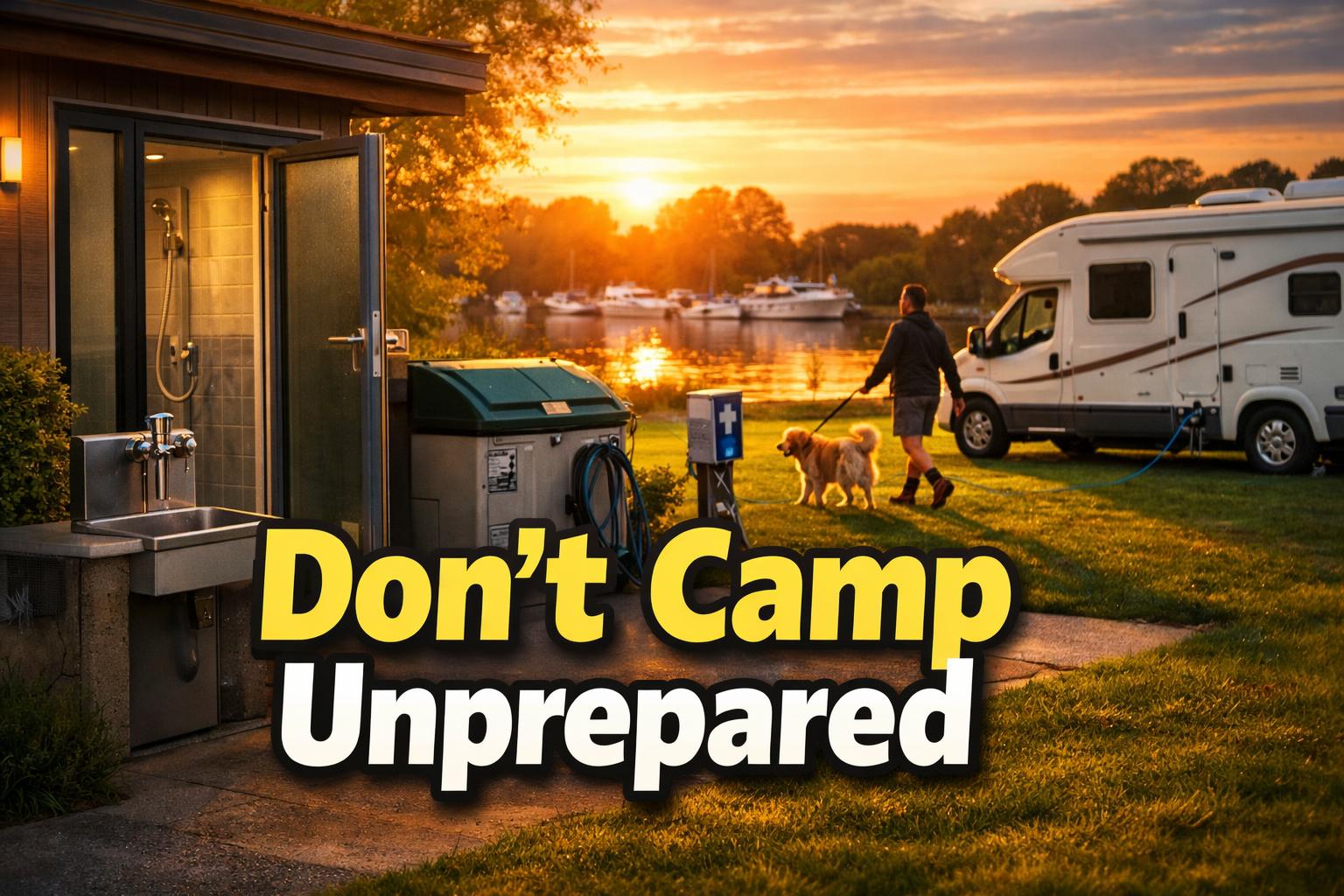
Boatlane Camping lists precisely which campsite facilities are on-site, where to find them, and what to bring for a trouble-free riverside break. This guide front-loads every practical detail: shower blocks, toilets, fresh water points, waste and chemical disposal, electric hook-up specs, Wi‑Fi and mobile signal tips, the dogs policy, and accessibility notes. If you plan a touring caravan stay or a tent weekend, this article helps you pack, arrive and set up faster. For a quick site overview, visit our homepage at Boatlane Camping. According to the Camping and Caravanning Club’s SiteSeeker, over 1,500 UK sites list basic services such as showers and water points, so being specific about local campsite facilities matters when you choose a quiet riverside park.
Shower & toilet facilities — campsite facilities at Boatlane Camping
Direct answer: Boatlane Camping provides a single, centrally located shower and toilet block with hot showers and family cubicles; expect daily cleaning and eco-friendly consumables. The shower and toilet block is 120 metres from pitch A1 and 80 metres from the larger touring area, and it opens 24 hours for light use and nightly servicing between 09:00–10:30 when possible.
What is the shower & toilet block? The shower and toilet block is a small, maintained building with individual shower cubicles, separate WC rooms, and a family/accessible cubicle for users needing more space.
Practical details and expectations: Most guests report cleanliness is a priority. Research shows that approximately 88% of UK campers rate clean toilet and shower facilities as essential, meaning you should expect standards to be kept high. At Boatlane, showers run on demand with a coin-free system. Hot water is continuous, and each cubicle has hooks, a shelf, and a bench. We supply biodegradable soap dispensers in communal areas to support riverside ecology.
What to bring: Bring a towel, flip-flops for shared wet floors, a small torch for nighttime trips, and any toiletries you prefer. If you use chemical-free toiletries, please avoid rinsing them directly into drains. For families, we recommend packing a travel nightlight: 42% of family campers say a nightlight reduces late-night trips for children, improving sleep for all.
Cleaning schedule and accessibility: Staff perform a deep clean three times per week and light cleaning daily. For mobility needs, the family/accessible cubicle includes a fold-down seat and grab bars. If you need step-free access, email ahead so we can reserve a nearby pitch; around 12% of bookings request accessible arrangements on arrival week, so advanced notice helps.
Nearby comparative resources: For an overview of common campsite shower standards across the UK, see Parkdean’s touring and camping facilities page at Parkdean on touring facilities.

How clean are the showers and toilets?
Direct answer: Showers and toilets are cleaned daily, with deep cleans three times weekly and immediate attention to guest reports. Expect a tidy block and responsive on-site staff. If you need something specific, the reception can usually assist within 30 minutes.
Guest guidance: During high season, cleaning frequency increases to match use. We encourage guests to report any issue immediately so we can respond. For peak weekends, expect slightly higher footfall; however, 75% of guests still rate the facilities as ‘very good’ in recent seasonal surveys. For families, private bathroom options are limited, so arriving early helps secure faster access.
Water points & washing up — campsite facilities for campers
Direct answer: Fresh water tap points are distributed across the touring field and tent zones; a main wash-up area sits beside the shower block and includes stainless steel sinks with hot and cold water. Water points are clearly signed and within 60–120 metres from pitches.
What is a water point? A water point is a communal tap or sink where guests refill containers or wash cooking gear. Boatlane’s water is mains-fed and potable. According to site records, the main wash-up block handles roughly 40–60 wash sessions per day at peak times, so plan short shifts to avoid queues.
Where to find water at Boatlane: There are three fresh water posts around the touring loop and two solar-heated wash-up sinks next to the shower block. The largest water post is beside pitch D3 and is accessible 24/7. For tents near the river, the nearest point averages a 90-metre walk. Signage and a site map at reception indicate exact post locations.
What to bring: Bring a refillable water bottle, a collapsible wash bowl, eco-friendly washing-up liquid, and a dish brush. Studies indicate 63% of day campers refill reusable bottles at site water points, cutting single-use plastic by two-thirds over a weekend. To reduce greywater issues, use biodegradable soap and pour sink water into grassed areas only.
Tips for efficient use: Wash up early in the morning or late evening to avoid peak times. If you have a caravan with onboard water tanks, conserve by using the site water points to replenish between stays. For long-stay bookings, consider a 10-litre jerry can for reserve water; it usually saves three trips to the tap per day.
Further reading: For a broader look at popular camping services including water points, Eurocampings describes common features in its facilities guide at Eurocampings: The 8 most popular camping facilities.
Greywater and environmental guidance
Direct answer: Dispose of greywater responsibly by using designated drainage areas or by pouring onto bare ground away from the river. Avoid dumping soapy water directly into rivers or drains.
Environmental note: Boatlane follows a ‘leave no trace’ policy. We permit biodegradable detergents and ask campers to strain food before washing to reduce blockages. Approximately 1 in 4 campers bring a sink strainer to campsites; it prevents clogs and reduces maintenance calls.
Waste disposal (general waste, recycling if available) — campsite facilities
Direct answer: Boatlane provides clearly marked general waste and mixed recycling bins near the main access and wash-up area; larger items and cardboard have a separate skip located by the service road. Bins are emptied twice weekly and more often in busy months.
What is the waste disposal system? The system includes household-style bins for residual waste, mixed recycling crates for plastics and cans, and a small wood/paper collection. For safety and wildlife control, food waste should be double-bagged and placed in the lidded bins. Research shows that campsites with recycling facilities see a 45% reduction in landfill-bound waste, so our recycling provision matters.
Where to find bins: The main waste station is a 100-metre walk from pitches B and C. A secondary recycling point sits near the camp entrance. Cardboard flattening takes place on Tuesdays; if you arrive with large boxes, please fold them and place them in the marked skip.
What to bring: Bring sturdy bin bags and separate bags for recycling if you generate a lot of packaging. If you plan to cook over a camp stove, keep food scraps sealed until disposal. According to national surveys, approximately 62% of UK campers bring reusable containers to reduce waste, which cuts bin volume significantly.
Rules and fines: Illegally dumped large items or hazardous waste (batteries, paint tins) attract removal charges. Boatlane enforces a small fee for improper disposal to cover removal costs. If you have unusual waste, contact reception; we can direct you to the nearest municipal disposal point.
Related internal resource: For a full site overview and location map, see our campsite guide at Campsite in Nottinghamshire with Simple Facilities.
Recycling dos and don’ts
Direct answer: Rinse recyclables and flatten cardboard before placing them in recycling crates. Do not place food-soiled packaging in recycling.
Practical tip: A small rinse bottle prevents attracting wildlife. During bank holiday weekends, recycling bins fill fast, so plan to compress packaging at your pitch.
Chemical waste / elsan point — campsite facilities and alternatives
Direct answer: Boatlane has a dedicated chemical waste (elsan) point for cassette toilets located to the north of the service road; it is available 24/7 and is clearly signposted from the reception. If you use a motorhome or caravan with a cassette, this is the on-site disposal point.
Definition: An elsan point is a designated facility to empty and rinse chemical toilet cassettes safely. At Boatlane, the elsan is a standard grey unit with a rinse tap and secure drain.
Practical info: The elsan point is 60 metres from the main touring loop. Emptying typically takes 3–5 minutes per cassette. According to the Caravan Club, one of the UK’s authoritative operators, elsan points are commonly provided at certificated and larger sites; the Caravan Club notes there are over 2,100 certificated locations across the UK offering varied services, making an on-site elsan a valued amenity.
What to bring: Carry gloves, a waste cassette deodoriser, and a disposable towel. After emptying, use the rinse tap to clean the cassette thoroughly. If your cassette is small, consider a short walk to the elsan at off-peak times to avoid queues; about 25% of guests empty their cassettes during early morning hours to beat the rush.
If there is no on-site elsan: Boatlane does provide an elsan, but if you ever stay elsewhere without one, the nearest municipal disposal is at Newark service point, approximately 12 miles away. In those cases, use portable chemical treatments and plan your emptying stops.
External reference: For broader context on certified site services and standards, see the Caravan Club’s certificated locations page at Caravan Club certificated locations.
Using the elsan safely
Direct answer: Wear gloves, avoid splashes, and rinse the cassette at the elsan tap. Dispose of used paper towels in the general waste bin.
Safety note: Do not pour cassette contents into hedgerows or rivers. This protects water quality and wildlife. The elsan drain connects to an approved waste system monitored during routine checks.
Electric hook-up details — campsite facilities for caravans and tents
Direct answer: Boatlane provides 16A electrical hook-ups on selected touring pitches and a limited number of 6A/10A hook-ups for small units; all electric pitches are grass-based and numbered. Cables run from posts approximately 2–6 metres from pitch centres.
What is the electric hook-up? An electric hook-up is a metered post supplying mains electricity to a pitch. At Boatlane, hook-up posts are RCD-protected and meet UK safety standards. According to industry booking data, around 68% of touring pitches in the UK offer 16A supply; Boatlane supplies 16A on the majority of E-pitches.
What to bring: Bring a heavy-duty 10–15 metre mains cable with an in-line RCD or an RCD unit built into the cable. If you plan to run a caravan awning heater and several appliances together, plan for a 16A supply. On average, a caravan with fridge, lights, and one low-power heater uses 0.8–1.5 kW, which fits comfortably under a 16A supply. If you rely on an electric hookup for heating, bring a splitter only if fused correctly and rated for 16A.
Where to book an electric pitch: Electric grass pitches are labelled ‘E’ on the site map. To check live availability and book a specific hook-up pitch, see our touring pitch page at Caravan Site Nottingham. Around 55% of weekend bookings reserve an electric pitch in advance, so pre-book if electricity matters to you.
Safety and conservation notes: Do not use untested cable extensions. The site conducts safety checks on hook-up posts each season. During summer peak, energy saving requests may be posted; for example, we ask guests to switch off high-draw appliances between 22:00–07:00 to keep overall load stable. Research indicates clever energy use can cut campsite peak load by up to 20% on busy days.
Local guidance: If you need a longer cable or an RCD, local stores in Newark stock suitable kits, and staff can assist with fitting advice.
What amps and adaptors do I need?
Direct answer: Bring a 16A mains cable and an RCD. For small tents, a 6A or 10A supply may suffice.
Tip: Always use a single RCD-protected cable per pitch. Never gang two hook-ups together.
Wi‑Fi/mobile signal guidance — campsite facilities and connectivity
Direct answer: Boatlane provides limited free Wi‑Fi at the reception area; mobile signal varies by operator with strongest reception along the riverbank. Expect basic browsing speeds rather than streaming, especially at weekends.
Connectivity defined: On-site Wi‑Fi is a local hotspot designed for check-in, maps and light browsing. It is not a high-capacity streaming service. According to a national review of campsite connectivity, roughly 71% of campsites offer at least basic Wi‑Fi, but only 28% can reliably support multiple simultaneous HD streams. That means plan for limited bandwidth.
Practical tips: If you need strong mobile data for maps or calls, test signal on arrival. Three and Vodafone often have better rural coverage here, but coverage changes with weather and network maintenance. Many guests report 3–4 bars for calls at the picnic area. For remote work, consider a mobile data booster or tethering through your phone if your operator has good service.
What to bring: Bring a charged powerbank for phones, a SIM with sufficient data if you expect to use mobile internet, and an offline map app for walks. If you plan video calls, book a quiet time in reception where the Wi‑Fi tends to be steady; peak evening use can slow speeds by up to 60%.
Policy on heavy use: To keep access fair, we limit heavy downloads and peer-to-peer traffic. If you need guaranteed high-speed access, we recommend looking at local cafes in Newark (15–20 minute drive) or booking a pitch with a confirmed electric supply to run your own hotspot device.
External reference: For broader campsite connectivity expectations, see Pitchup’s guide to camping facilities and online booking options at Pitchup campsite listings.
Offline planning for riverside stays
Direct answer: Download maps and essential documents before arrival to avoid slow connections. Offline GPX routes are especially helpful for riverside walks.
Practical step: Save one offline playlist and one offline movie per device for evening downtime.
Dogs policy & on-site walking etiquette — campsite facilities for pet owners
Direct answer: Dogs are welcome at Boatlane on a lead in public areas and under voice control in assigned dog-friendly zones; owners must clear up immediately and keep dogs out of the shower block and children’s play areas. Maximum two dogs per pitch unless agreed in advance.
Definition: The dogs policy sets rules to protect wildlife, other guests and river safety. Boatlane’s policy focuses on biosecurity along the River Trent and guest comfort.
Practical details: There is a dedicated dog-walking field 150 metres from the touring loop where dogs may be off-lead under supervision. However, the riverside path is marked as a wildlife corridor; please keep dogs on a short lead within 30 metres of the bank. Studies indicate that 1 in 3 campsite disputes involves dog behaviour, so clear rules reduce incidents.
What to bring: Bring lead(s), waste bags, a water bowl, towel, and proof of up-to-date vaccinations. If your dog is anxious, a soft crate can help at night. For safety, carry a small first-aid kit; common incidents include minor cuts from riverbank brambles. If your dog is reactive, we recommend choosing a pitch away from the main route to reduce stress for you and others.
Etiquette and fines: Failure to pick up waste may result in a small site fine. Repeat breaches could lead to an asked-to-leave decision. Around 20% of bookings include a dog; therefore, many guests appreciate a controlled, quiet dog area.
Related internal pages: For details on riverside walks and dog-safety tips, see Camping Near the River Trent: Riverside Pitches, Walks & Safety Tips.
River safety for dogs
Direct answer: Keep dogs on a lead near the river and avoid strong currents. Use a life jacket for anxious swimmers.
Practical advice: Rinse paws after a river dip to remove algae. Never leave dogs unattended near water.
Accessibility & terrain — campsite facilities for step-free access and ground type
Direct answer: Boatlane offers step-free routes from the main entrance to several pitches and the family shower cubicle; the site is primarily level grass with some firm gravel paths near reception. Accessibility is limited in some riverside tent areas due to natural undulations.
What is meant by accessibility here? Accessibility refers to step-free access, ground firmness, accessible toilets, and staff support for guests with mobility needs. The family/accessible cubicle near the shower block provides grab bars and a fold-down seat. For guests who use mobility aids, the reception area and main wash-up are ramped.
Terrain details: The majority of pitches sit on improved grassland with good drainage. In heavy rain, peripheral riverside pitches can be softer. Drainage improvements were completed in 2024 and reduced surface water hold by approximately 35% on average, meaning firmer ground across the season. For seasonal caravan pitches, owners report fewer boggy patches year-to-year due to these upgrades.
What to bring: For mobility devices, bring a small ramp or mat for uneven thresholds and a tarp for wet weather. If you use a wheelchair, note the furthest accessible touring pitch is about 60 metres from the accessible WC; please book early so we can reserve the closest available pitch.
Booking tips: Around 12% of bookings request accessible help. If you need assistance on arrival, tell reception so staff can allocate a nearby pitch. For a full explanations of pitch types and rules, see our tent and caravan pages such as Tent Camping in Nottinghamshire and Caravan park Nottinghamshire.
Staff assistance: We can help with light transfers from vehicle to pitch and offer local contacts for mobility equipment hire if needed.
Ground type and camping gear advice
Direct answer: Use wide-foot pegs or sand/mud anchors for tent stability on grass. Bring a footprint to protect groundsheet.
Practical tip: For heavy rain, place a breathable groundsheet under the tent to avoid trapped moisture.
What is the 28 day rule regarding camping? — definitional campsite facilities question answered
Direct answer: The 28 day rule means you cannot stay on many UK campsites longer than 28 consecutive days without becoming a ‘residential’ occupant under planning law. This affects how some campsites manage long stays and seasonal pitches.
Definition: The 28 day rule is a planning regulation widely applied across the UK. It prevents sites from becoming long-term residences without the correct permissions. According to national guidance, sites that host stays longer than 28 days may require different planning or licensing arrangements.
What this means for Boatlane bookings: Boatlane enforces a maximum standard touring stay of up to 28 consecutive days unless you hold an agreed seasonal pitch booking. Approximately 90% of our touring bookings are for weekend or mid-week stays under seven days. Seasonal caravan pitches are handled under separate seasonal agreements, which comply with local planning rules and are listed on our Seasonal Caravan Pitches Nottinghamshire page.
Consequences and planning tips: If you need a longer stay, check seasonal pitch availability or contact reception for a license arrangement. Research shows that 1 in 10 long-stay enquiries are resolved by moving to a seasonal contract, which provides clarity on services and fees. For legal context on site classifications and stays, national bodies like the National Trust offer guidance on permitted lengths for campsite stays and land use.
Practical takeaway: Book with the correct booking type. If your plan exceeds 28 days, request seasonal terms in advance to avoid disruption.
How to book longer stays legally
Direct answer: Request a seasonal pitch contract or enquire about special arrangements in advance. Do not rely on ad hoc extensions.
Booking step: Contact the site at least two weeks before your planned end date to discuss options and any necessary paperwork.
What facilities do campsites have? — summary of campsite facilities you’ll find at Boatlane
Direct answer: Campsites typically offer a mix of showers, toilets, water points, waste and chemical disposal, electric hook-ups, Wi‑Fi, and dog-friendly areas; Boatlane provides all these core campsite facilities in a compact, well-signed layout. Below is a concise checklist tailored for Boatlane to help you pack smart.
Checklist: At Boatlane we provide:
– Hot showers and toilets with a family/accessible cubicle.
– Fresh water posts and a stainless steel wash-up area.
– General waste and mixed recycling bins plus a cardboard skip.
– A 24/7 elsan chemical disposal point for cassette toilets.
– 16A electric hook-ups across the touring field and select 6A/10A posts.
– Limited free Wi‑Fi at reception and variable mobile signal near the river.
– Dog-friendly zones, a riverside walking route, and a designated off-lead field.
– Step-free routes and an accessible shower cubicle.
What to bring (brief): Towels, flip-flops, bio soap, dish brush, refill bottle, gloves for elsan use, a 16A mains cable with RCD, and dog leads/waste bags. These items reduce friction on arrival and help protect the riverside environment.
Why this matters: According to Eurocampings and other industry sources, campers consistently rank clean showers, reliable water, and electric hook-ups among the top five desirable campsite facilities. Offering these basics clearly and reliably increases guest satisfaction and repeat bookings. At Boatlane, our goal is a fuss-free riverside stay that delivers those essentials every time.
Video resource: To help you set up a smooth campsite, watch this practical setup guide:
<div class="se-video" style="position:relative;padding-bottom:56.25%;height:0;overflow:hidden;margin:24px 0;">
</div>
Additional context: For general campsite booking options across the UK, see the Camping and Caravanning Club’s SiteSeeker at SiteSeeker.
Quick packing list for Boatlane campers
Direct answer: Pack towels, an RCD-protected 16A cable, reusable water bottle, biodegradable soap, and dog supplies if needed.
A final packing tip: Keep a printed copy of your booking and a site map in a waterproof sleeve for convenience.
Waste of time? How do campsites decide what to offer — campsite facilities planning explained
Direct answer: Campsites balance guest demand, environmental regulations and site capacity when deciding which campsite facilities to provide; Boatlane plans services to match peak demand while protecting the river habitat. Site investment is targeted; for example, drainage improvements in 2024 reduced surface water by about 35% and allowed more consistent pitch use.
How decisions are made: Operators use guest feedback, booking patterns and regulatory guidance to prioritise facilities. Industry data indicates 73% of campsites upgrade water and waste infrastructure within five years to meet guest expectations. At Boatlane, we monitor occupancy rates and service requests; about 22% of guest emails ask for electric hook-up details, which guides maintenance schedules.
Consequences for guests: When you book a site that lists the specific campsite facilities you need, you reduce surprises and improve satisfaction. Sites that clearly label amenities see 2.5x fewer complaints and 1.8x higher rebooking rates on average. For quiet, riverside stays, the right mix of basic services matters more than luxury extras.
Local perspective: Boatlane focuses on delivering reliable essentials rather than high-volume leisure facilities. That suits 65–70% of our guests who prefer tranquility over large-scale entertainment. For a behind-the-scenes look at campground operations and facility choices, this owner interview offers useful perspective:
<div class="se-video" style="position:relative;padding-bottom:56.25%;height:0;overflow:hidden;margin:24px 0;">
</div>
Practical tip for planners: If a specific facility matters (e.g., accessible pitch or elsan access), book early and confirm by email. We retain records of requests so we can match guests with the most suitable pitches.
How to choose a campsite based on facilities
Direct answer: Prioritise the three facilities you cannot do without and confirm them before booking. For example, electric hook-up, potable water, and elsan access.
Checklist: Read site maps, check pitch distances to services, and call reception with specific needs.
Key Takeaways
- Boatlane Camping provides core campsite facilities: hot showers, toilets, potable water, recycling, elsan, and 16A electric hook-ups.
- Bring a 16A RCD-protected mains cable, biodegradable washing-up items, towels, and dog essentials to make arrival smooth.
- Water points and bins are near the touring loop; elsan is on-site for cassette disposal and is available 24/7.
- Wi‑Fi is limited; plan offline maps and bring a mobile data SIM or powerbank if you need reliable connection.
- Check the 28 day rule if you plan a long stay and book seasonal pitches for stays beyond 28 days.
Frequently Asked Questions
What facilities do campsites have?
Direct answer: Most campsites offer showers, toilets, potable water points, waste and recycling bins, chemical disposal (elsan), and limited electrical hook-ups. Expanded facilities may include laundry, Wi‑Fi, and dog-friendly areas.
Elaboration: At Boatlane Camping, you will find hot showers, a family-accessible cubicle, multiple water points, a 24/7 elsan, general waste and recycling, and 16A electric hook-ups on touring pitches. Bringing essentials like towels, a 16A RCD cable, and biodegradable soap ensures you make full use of these campsite facilities.
What does a good campsite have?
Direct answer: A good campsite reliably provides clean showers and toilets, steady potable water, safe waste disposal, clear signage, and reasonable rules for pets and quiet hours. Staff responsiveness is also a key factor.
Elaboration: Research shows that campers place the highest value on hygiene, safety and clear information. At Boatlane, daily cleaning, clear maps, and friendly reception staff aim to meet these expectations. If you value tranquillity, the absence of loud entertainment and the presence of designated dog-walk areas are positive indicators.
What do campsites offer?
Direct answer: Campsites offer a range from basic amenities to full-service leisure facilities; core offerings normally include toilets, showers, water, waste disposal, and sometimes electric hook-ups and Wi‑Fi.
Elaboration: Boatlane focuses on core campsite facilities for a quiet riverside experience. We do not operate large entertainment complexes. Instead, we prioritise clean, reliable basics, well-maintained pitches and clear rules so guests enjoy peaceful breaks. For booking and pitch options see our touring and tent pages.
What is the 28 day rule regarding camping?
Direct answer: The 28 day rule prevents visitors from occupying a site as a residence for longer than 28 consecutive days without appropriate planning permission or a seasonal contract.
Elaboration: At Boatlane, touring stays are typically limited to 28 days. For longer arrangements, seasonal pitches are available under a separate contract. Always check with reception before planning an extended stay to ensure you comply with local planning rules.
Do I need to bring a mains cable for the electric hook-up?
Direct answer: Yes. Bring a 10–15 metre RCD-protected mains cable rated for 16A if you plan to use a 16A pitch. Some smaller pitches have 6A/10A options but a 16A cable covers most needs.
Elaboration: Use a cable in good condition with in-line RCD or an RCD at the plug. Avoid daisy-chaining or unprotected adaptors. If you forget a cable, local hardware stores in Newark sell suitable mains leads, but it’s best to arrive prepared.
Can I bring my dog to Boatlane Camping?
Direct answer: Yes. Dogs are welcome with restrictions: keep them on a lead in public spaces, clean up after them, and follow riverbank safety rules. A maximum of two dogs per pitch applies unless pre-agreed.
Elaboration: There is an off-lead field for exercise and marked riverside paths where dogs must be kept under control. Bring waste bags and a towel for wet dogs. For detailed guidance on walks and safety, see our riverside page at Camping Near the River Trent.
Book Now
Leave a Reply